
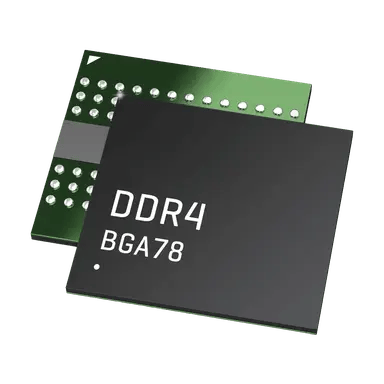
DDR4 components for industrial applications
Released to the market in 2014, DDR4 is a high-performance memory designed for large-scale workloads at higher speeds. No wonder it has become an essential component in embedded and industrial designs. And even though the major memory manufacturers withdraw from DDR4, it will remain a relevant technology in many industry applications.
DDR4 differs from previous DRAM generations in several important ways:
Unlike previous generations of DDR memory, prefetch has not been increased above the 8n used in DDR3. The basic burst size is eight 64-bit words, and higher bandwidths are achieved by sending more read/write commands per second.
It’s important to note that DDR4 is not compatible with any earlier type of RAM due to different signaling voltage and physical interface, and reduced power consumption.
We offer DDR4 components from Intelligent Memory, NANYA, Samsung, Sk hynix, and Winbond. However, Samsung and SK Hynix have announced that they will phase out certain DDR4 products.
Reach out if you are looking for alternatives!



Our Manufacturers:




Density: 4Gb - 32Gb
Speed: up to 1600MHz
Temperature: commercial and industrial grades






Organisation: x4, x8, x16
Voltage: 1.2V
Package: FBGA78, FBGA96
Other features:
Supported Data Bus Inversion (DBI)
Supported Write Cycle Redundancy Check (CRC)
Supported Dynamic ODT (On Die Termination)
Supported Fine Granularity Refresh Mode
Product Highlights & Benefits:
Increased Bandwidth up to 3,200 Mbps
25% less power consumption
Lower latency for improved multitasking
Enhanced Error Detection and Correction
DDR3 vs. DDR4
Higher speed and performance: Typical DDR4 runs up to 1600 MHz vs 1066 MHz for DDR3.
Lower power consumption: 1.2 V for DDR4, which means cooler and more efficient systems.
Higher Densities: DDR4 modules commonly 16–32 GB vs DDR3 typically 4–8 GB.
Smoother multitasking: DDR4 offers 16 banks in bank groups, which means smoother performance under load.
Applications:
IoT : System on Modules (SOM), Data loggers, Smart Meters
Computer on Modules : ATMs and industrial control systems
Smart TVs, DTV
Set Top Box (STB)
Telecom Infrastructure (CPE)
Surveillance Cameras
Servers
Robotics
FAQs:
Is it worth switching from DDR3 to DDR4?
Yes, if your platform supports it. DDR4 gives higher bandwidth, lower power, and larger module sizes. You’ll notice gains in multitasking, memory-heavy apps, and power-sensitive systems. If you’re locked to a legacy CPU/board, stay on DDR3 until you upgrade the platform.
How long is DDR4 supported by memory manufacturers?
DDR4 has long-tail availability even as DDR5 grows. Industrial suppliers often offer multi-year lifecycle support (varies by Manufactures).
Is DDR4 suitable for harsh industrial environments?
Yes, DDR4 is suitable for harsh industrial environments when using industrial-grade modules, which are designed to operate under wide temperature ranges and offer reliable performance in rugged conditions.
What is the most common DDR4 configuration used in industrial environments?
8–16 GB, DDR4-2666 to DDR4-3200, 1.2 V, x8 Interface, Industrial-temperature (-40~95 °C)
HeadQuater
Av. Presidente Juscelio Kubitschek, 1909-Torre Sul, 10 andar, 0455-065, Sao Paulo, Brazil
Contacts
+55 11 95846 3995
info@apexmemory.tech
Branches
- 1388 Kifer Road Sunnyvale, CA 94086. USA
- 2-16-5 Konan, Minato-ku, Tokyo, 108-0075 Japan
- Tamara-Danz-Straße 2, 10243 Berlin, Germany
- 41 sir Lowry road, Woodstock cape town, South Africa
Exclusive Online Shopping Experience
Our products are available for purchase exclusively through our website. We do not operate as a physical retail store and, as such, do not offer in-store shopping options.
We pride ourselves on customer loyalty as a result of great pre & post sale service. All products are covered by manufacturer warranty. Customer service is our credo.