
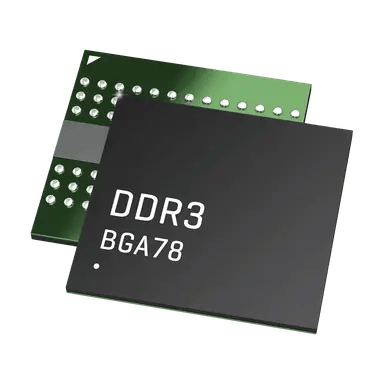
DDR3
Since JEDEC published the DDR3 SDRAM specification in 2007, DDR3 SDRAM is one of the most common DRAM technologies in industrial, embedded as well as a variety of other applications. However, many manufacturers have announced to discontinue DDR3 components.
Thanks to our broad linecard, we still offer a broad range of DDR3 in a variety of configurations from these manufacturers: Chiplus, ESMT, Etron, Intelligent Memory, Nanya, and Winbond.


Our Manufacturers:






Density: 1Gb - 8Gb
Speed: up to 1066MHz
Temperature: commercial and industrial grades






Organisation: x4, x8, x16
Voltage: 1.5/1.35V
Package: FBGA78, FBGA96
Other features:
Supported Data Bus Inversion (DBI)
Supported Write Cycle Redundancy Check (CRC)
Supported Dynamic ODT (On Die Termination)
Supported Fine Granularity Refresh Mode
Product Highlights & Benefits:
High speed and performance
Energy efficient
Improved data handling
DDR3 vs. DDR4
Fast performance: Typical DDR3 runs up to 1066 MHz vs 533 MHz for DDR2.
Energy Efficient: 1.5 V (1.35 V for DDR3L) for DDR3, helping reduce power consumption and heat generation.
Improved Data Handling: Features 8-bit prefetch and up to 8 bank groups, allowing better everyday tasks and throughput for demanding applications.
Applications
Industrial
Smart TV
Set Top Box (STB), Printers, POS Machine
Surveillance camera
Power equipment
FAQs:
Can I replace DDR3 with DDR4?
No, DDR3 is not compatible withDDR4 due to different pin configurations and electrical standards:
different pin layout (240 pins vs. 288 pins)
different voltage (1.5V vs. 1.2V)
different signal specification
To upgrade from DDR3 to DDR4 you need:
a DDR4 compatible CPU and motherboard
a complete platform re-design
Why is DDR3 still used in industrial systems?
DDR3 remains popular due to its long-term availability, low power consumption, and compatibility with legacy systems.
What is the most common DDR3 configuration used in industrial environments?
Our customers are most interested in these DDR3 features: 8Gb, DDR3-1600 to DDR3-1866, 1.5V or 1.35V (DDR3L), x8 / x16 interface, industrial temperature range (−40°C~85°C or up to 95°C for extended versions).
What is the long-term outlook for DDR3 beyond 2030?
DDR3 demand will be extremely niche beyond 2030. Processor ecosystems are already phasing out DDR3. Support will only remain where customers are willing to commit to wafer banking or custom long-tail supply programs. The availabilty beyond 2030 will be limited to legacy maintenance markets (industrial, defense, aerospace).
HeadQuater
Av. Presidente Juscelio Kubitschek, 1909-Torre Sul, 10 andar, 0455-065, Sao Paulo, Brazil
Contacts
+55 11 95846 3995
info@apexmemory.tech
Branches
- 1388 Kifer Road Sunnyvale, CA 94086. USA
- 2-16-5 Konan, Minato-ku, Tokyo, 108-0075 Japan
- Tamara-Danz-Straße 2, 10243 Berlin, Germany
- 41 sir Lowry road, Woodstock cape town, South Africa
Exclusive Online Shopping Experience
Our products are available for purchase exclusively through our website. We do not operate as a physical retail store and, as such, do not offer in-store shopping options.
We pride ourselves on customer loyalty as a result of great pre & post sale service. All products are covered by manufacturer warranty. Customer service is our credo.