
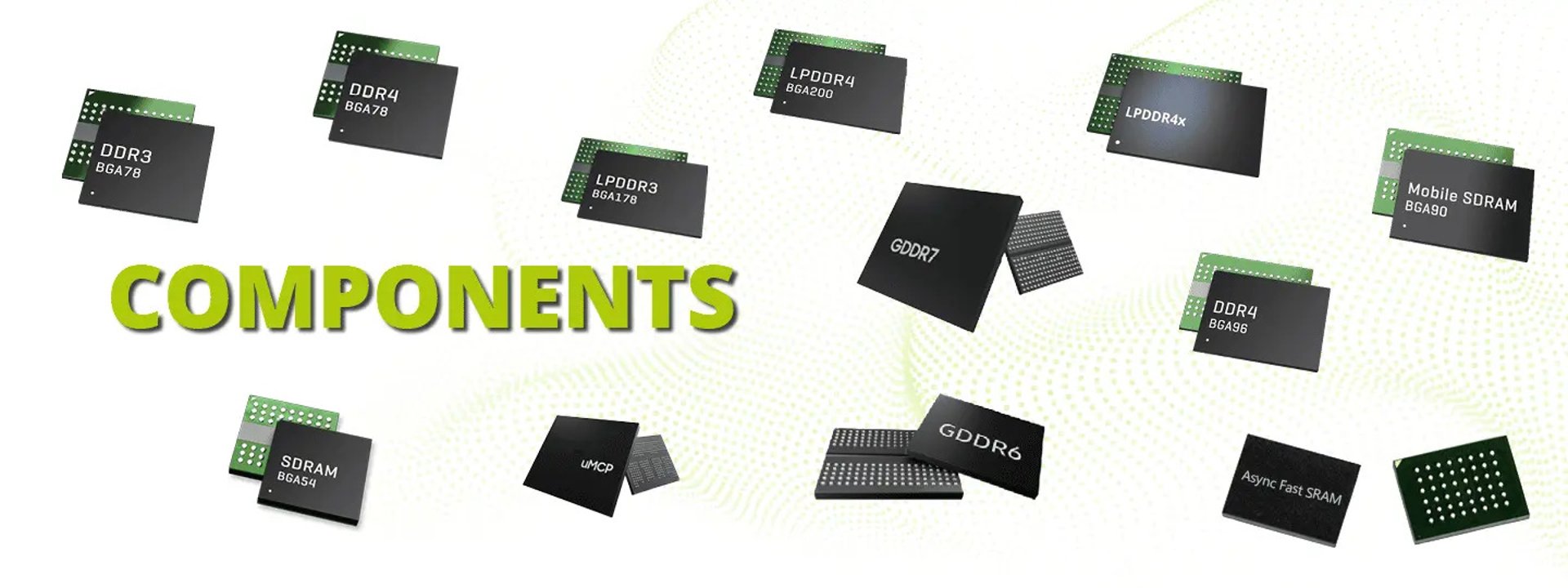
Memory Components
Memory semiconductors are essential components in modern electronic devices, enabling data storage and processing across a range of applications, from smartphones to data centers. They are categorized based on functionality, technology, and architecture, with each type serving specific performance and cost requirements. Below is an overview of the primary types of memory semiconductor components. By clicking on the links you will get to a more detailed overview of the types of components in our portfolio:
1. Volatile Memory
Volatile memory requires continuous power to retain data and is used for temporary storage and fast data access. It stores data in capacitors that require periodic refreshing.
Dynamic Random Access Memory (DRAM)
High density and cost-effective.
We carry the following subtypes: DDR or DDR1, DDR2, DDR3, DDR4, DDR5, SDRAM, LPSDR, LPDDR1, LPDDR2, LPDDR3, LPDDR4, LPDDR4x, LPDDR5, and LPDDR5x.
Applications: System memory for computers, servers, and mobile devices.
Graphics Double Data Rate (GDDR) Memory
Description: GDDR is a type of DRAM optimized for graphics processing and high-bandwidth applications.
Designed for parallel processing with high data transfer rates and low latency.
GDDR6X employs PAM4 (Pulse Amplitude Modulation) for even higher bandwidth.
Applications: Graphics cards, gaming consoles, AI accelerators, and high-performance computing.
Static Random Access Memory (SRAM)
Description: SRAM uses flip-flop circuits to store data without requiring periodic refresh.
Faster than DRAM but less dense and more expensive
We offer Asynchronous FAST SRAM, Low Power SRAM, Synchronous SRAM, Non-volatile SRAM and Pseudo SRAM
Applications: Cache memory in CPUs, GPUs, and networking hardware.
2. Non-Volatile Memory (NVM)
Non-volatile memory retains data without power, making it suitable for long-term storage.
Flash Memory
Description: Flash memory stores data using floating-gate transistors.
Electrically erasable and reprogrammable.
You can find and overview of the NAND and NOR flash technologies that we carry in our section Flash Memory.
Applications: Solid-state drives (SSDs), USB drives, memory cards.
Emerging Memory Technologies
Emerging technologies aim to address limitations in speed, density, and scalability.
Magnetoresistive Random Access Memory (MRAM)
Description: MRAM is a non-volatile memory technology that stores data using magnetic states instead of electrical charges like DRAM.
+10 Year data retention at 89°C
Nearly unlimited endurance
Applications: Automotive, IoT devices.
Resistive Random Access Memory (ReRAM)
Description: ReRAM is a type of non-volatile electronic memory that stores information by changing the electrical resistance of a weakly conductive material.
Very low operating current during read operations
Unlimited number of read operations
Applications: Suitable for applications with high program read frequency such as AI hardware and storage-class memory.
Ferroelectric RAM (FeRAM / FRAM)
Description: FeRAM is a random-access memory similar in construction to DRAM but using a ferroelectric layer to achieve non-volatility.
Fast read and write at low power consumption
No need to erase data before writing
Nearly infinite rewrite endurance
Applications: Medical devices, secure systems and replacement of EEPROM or SRAM
HeadQuater
169 Great Portland St, London W1W 5PF, United Kingdom
Contacts
info@apexmemory.tech
Branche
Calle Menorca 18, 46023 Valencia, Spain
Exclusive Online Shopping Experience
Our products are available for purchase exclusively through our website. We do not operate as a physical retail store and, as such, do not offer in-store shopping options.
We pride ourselves on customer loyalty as a result of great pre & post sale service. All products are covered by manufacturer warranty. Customer service is our credo.